
NBA PRA Bet Meaning: Points, Rebounds and Assists Explained
 Available in US
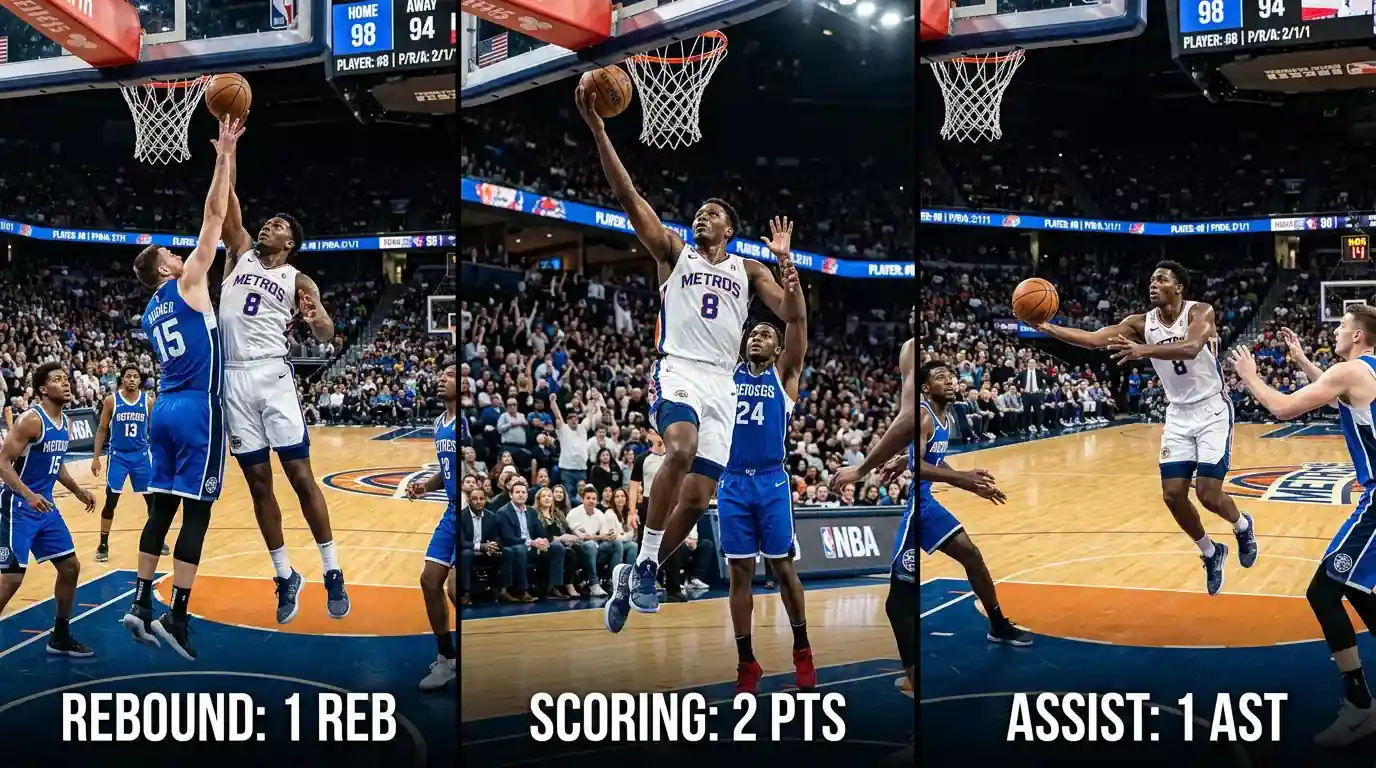
PRA Bets Combine Three Stats in One Line — and That Changes the Maths Entirely
The first time a betting site showed me a PRA line, I assumed it was just a lazy way to bet on a player’s overall night. It took me a while to appreciate why PRA props are structurally different from individual stat props — and once I did, I started thinking about them in a completely different way. When you bet a player’s points, rebounds, and assists as a combined total over a single number, the variance of the individual components partly cancels out. A player who has a quiet scoring night might compensate with extra rebounds and assists, keeping the combined total near expectation even when individual stats disappoint.
PRA (Points + Rebounds + Assists) is a combined statistical prop: the bettor wagers on whether the sum of those three counting stats will go over or under a set line. Available at most major UK bookmakers for the top 30–40 players by usage and name recognition, it’s become the standard market for “general player productivity” bets — and it serves a specific analytical purpose beyond convenience. It’s where I go when I have a view on a player’s overall involvement in the game but less certainty about how that involvement distributes across scoring, playmaking, and rebounding specifically.
How Bookmakers Build a PRA Line Differently From Individual Stat Props
A PRA line is not simply the sum of a player’s individual points, rebounds, and assists lines added together. Bookmakers apply a discount when combining stats, because the combined total has lower variance than three independent props — the covariance between the three stats matters. A player who scores fewer points in a given game often makes up for it with more passes and movement, which can increase rebounds and assists. That negative correlation between scoring and playmaking output partially smooths the combined distribution.
The practical implication: a player with individual lines of points 22.5 + rebounds 7.5 + assists 5.5 = 35.5 might have a PRA line set at 33.5 or 34.5, not 35.5. The bookmaker discounts for the smoothing effect. When you encounter a PRA line that appears to be set at the simple sum of individual stat lines — which happens occasionally, particularly for mid-tier players — that’s a potential inefficiency worth investigating.
Elijah Jackson of sportsgambler.com captured the essential principle: prop analysis should focus on usage, minute distribution, and matchup context rather than headline box-score figures. For PRA props specifically, the matchup context works in aggregate — you’re asking whether the player’s total involvement, across all three statistical domains, will exceed or fall short of the line. That’s a different question from asking whether his scoring will exceed a specific number.
PRA vs Individual Props: Which Offers Better Value?
The answer depends on what kind of edge you have. If your research gives you a specific, high-confidence view on one component — say, you’re highly confident a player will exceed his rebounds line because of a favourable matchup — then the individual rebounds prop is the better vehicle. Combining that view into a PRA bet dilutes your edge by mixing it with the other two components where you have less certainty.
PRA props are most valuable when you have a general conviction about a player’s overall involvement without strong specific views on the component distribution. A player returning from a minor injury who has historically taken a game or two to fully regain shooting rhythm might disappoint on points but still contribute heavily in assists and rebounds. The PRA line might not reflect that distributional shift as accurately as a pure points line would — creating a scenario where the individual points market correctly prices a quiet scoring night, but the PRA line is still set as if the full contribution will come through scoring.
The market data gives some context: only 2% of all basketball bets currently go through player props, which means the pricing inefficiencies that exist in individual stat markets are even more pronounced in combined markets like PRA where the modelling complexity is higher. Markets that fewer people bet are markets where initial pricing errors persist longer.
Player Profiles That Suit PRA Betting
Three player archetypes produce the most consistent PRA betting opportunities. First: the “triple-double threat” — high-usage players whose game-to-game scoring, rebounding, and assists distributions vary significantly but whose combined total is remarkably stable. These players are excellent PRA targets because the line reflects their combined productivity accurately, and the component variance creates individual line inefficiencies that the PRA line doesn’t share.
Second: versatile forwards who split their production across all three categories without being elite in any one. Their individual lines are each set at moderate levels, and the bookmaker’s model for each component carries more uncertainty than it does for specialist scorers or rebounders. The PRA line for these players is often a softer projection than the sum of the individual lines would suggest.
Third: point guards in transition-heavy offences who accumulate assists and rebounds in volume beyond what scoring-focused analysis would predict. When these players face up-tempo opponents, the PRA line — which already accounts for their assist-heavy profile — can look conservative relative to the scoring line, which is where casual bettor interest concentrates.
Timing matters as much as player type. PRA prop lines are released at the same time as individual stat props — typically morning of game day at major UK bookmakers. The best opportunities appear shortly after release, before sharp money has fully worked through the combined-stat pricing. A player whose individual lines have already been adjusted for an injury absence or a rotation change may still have a PRA line that reflects the pre-adjustment baseline. Checking both simultaneously is the best practice.
One area where I find PRA props consistently valuable is for players returning from minor injuries. A player who missed two games with a hamstring strain may come back on a minutes restriction — limiting his scoring ceiling — but his playmaking and rebounding contributions often return to full volume within one or two games. The PRA line, if set based on his recent absence, may underestimate his total involvement. Individual scoring props in this situation are harder to read because his scoring pace genuinely may take a game to return. The PRA line captures the full contribution and can be more fairly valued in that context.
For a deeper understanding of how individual player props work before moving into combined markets, the fundamentals of NBA player prop betting provide the framework for evaluating any line type at UK bookmakers.
How does a bookmaker build a PRA line differently from individual stat props?
A PRA line is not simply the sum of the individual points, rebounds, and assists lines. Bookmakers apply a discount to account for the covariance between stats — because when scoring is down, playmaking and rebounding often partially compensate, reducing the combined total’s variance. This smoothing effect means the PRA line is typically set below the arithmetic sum of the three individual lines.
Which types of players typically have the highest PRA lines?
High-usage players with all-around statistical profiles — primary ball-handlers who score, create for others, and contribute on the glass — produce the highest PRA lines. Versatile forwards and elite point forwards also appear frequently at the top of PRA lines because their involvement spans all three statistical categories consistently across game contexts.
Prepared by the nba Props Bets editorial staff.