7 NBA Prop Bet Mistakes UK Bettors Make — and How to Fix Each One
 Available in US

NBA Prop Betting Looks Simple — That’s Exactly Why Most Bettors Get It Wrong
The worst thing that ever happened to my NBA prop betting was winning my first six bets. Six wins from six convinced me I understood something I didn’t — that player props were easy, that my instincts were reliable, and that consistent research was optional. The correction came eventually, and it cost more than those six initial wins earned. Looking back, I’d rather have lost the first six and learned the right lessons immediately.
The mistakes I made in my early years are the same ones I see repeatedly in how casual NBA prop bettors approach the market. They’re not exotic errors that require sophisticated analysis to avoid; they’re mostly discipline failures and cognitive biases that are entirely correctable once you know what to look for. The reason only 3–5% of sports bettors are consistently profitable long-term isn’t primarily analytical incapacity — it’s that the other 95–97% haven’t built the process discipline to override the mistakes described below.
Seven Mistakes That Erode NBA Prop Bettor Edge
Mistake one: not checking the injury report before betting. This is the most practically impactful and most commonly committed error in NBA prop betting. The official injury report, released at 5pm Eastern on game day, contains information that directly affects every prop on a given slate. A teammate’s absence reshuffles usage across the roster; a player’s own Questionable designation changes his probability of playing; a late scratch can make a bet void or suddenly make a previously borderline line look very attractive. Placing any NBA prop bet without first checking today’s injury report is analytically equivalent to betting on a horse race without knowing if the horse has been withdrawn.
Mistake two: anchoring to the previous game’s performance. A player who dropped 42 points last night is not more likely to go over his points prop tomorrow; his prop line has already been raised to reflect that performance, and regression toward his mean is statistically more probable than a repeat. The most common public error in NBA prop betting is over-weighting the most recent standout performance — which is exactly why post-big-game overs are often mispriced in the under direction. Public money floods the over; sharp money sometimes takes the corrective position.
Mistake three: ignoring line movement. When a line moves significantly between opening and close — say, a points prop moves from 23.5 to 25.5 in the hours before tip-off — that movement carries information. Usually it signals that informed money has identified something: an injury, a lineup change, a usage shift. Most casual bettors either don’t notice line movement or treat it as noise. Systematic bettors treat significant early-market movement as a cue to investigate before placing a bet on the now-moved line.
Mistake four: betting too many games per day. The average NBA slate includes 8–12 games, which means 80–120+ available player prop markets on any given night. Betting extensively across a full slate without deep research on each game is not diversification — it’s dilution of analytical quality. The bets where you have genuine research-backed edge are a small fraction of the available market. Concentrating on those bets and passing on the rest is more profitable than spreading stakes thin across markets you haven’t properly evaluated.
Mistake five: staking inconsistently across bets of different confidence levels without a framework. Staking £50 on a bet you’re “very confident” about and £10 on one you’re “fairly confident” about sounds rational. But without a documented framework defining what those confidence levels mean in probability terms, you’re just scaling stakes to emotional conviction rather than analytical edge. Emotional conviction and analytical edge are not the same thing — and the bets where your conviction is highest are sometimes the ones most corrupted by cognitive bias.
Mistake six: not keeping records. Every bettor thinks they’re winning more than they are. The psychological bias toward remembering wins and forgetting losses is well-documented and affects virtually everyone who isn’t tracking results systematically. A basic spreadsheet recording bet, line, odds, estimated probability, and outcome provides the objective data needed to assess whether your process is actually working. Without it, you’re navigating with a map you’ve drawn from faulty memory.
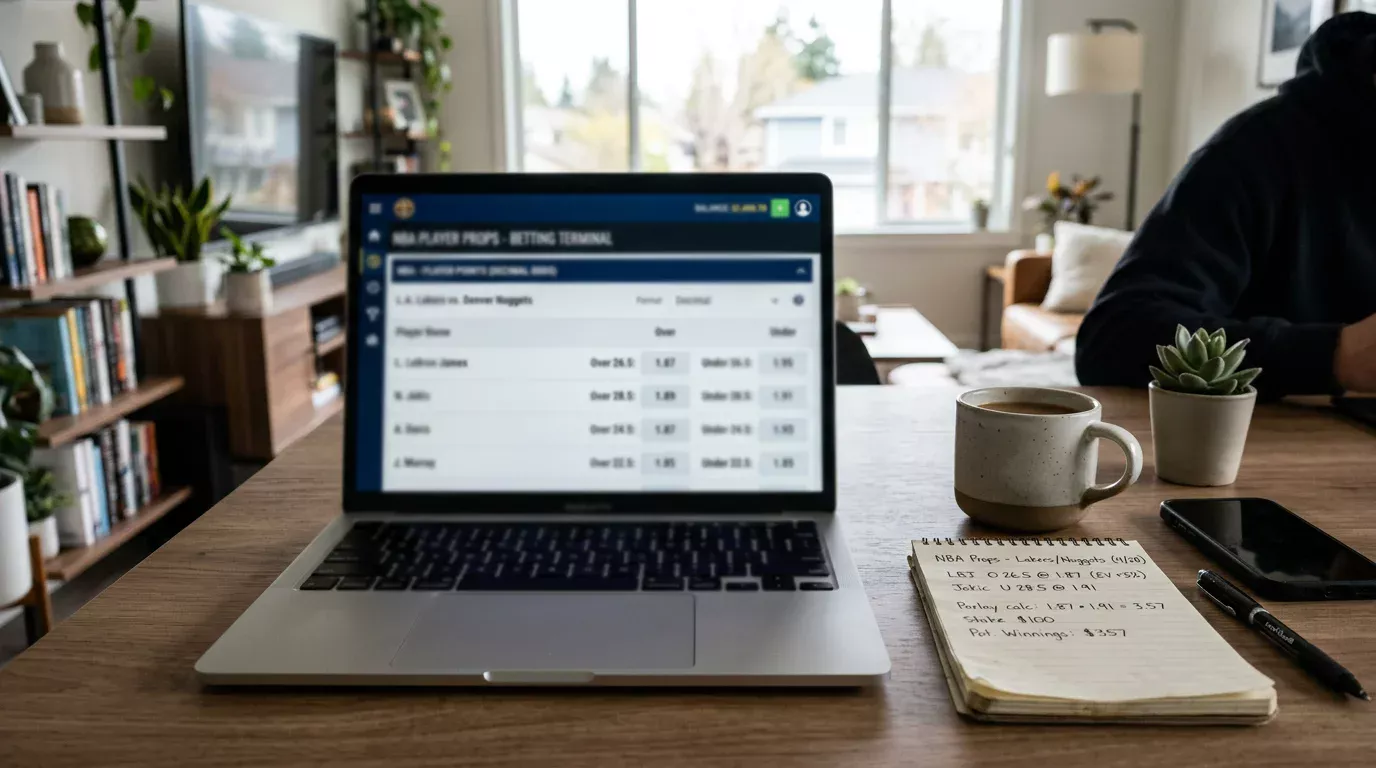
Mistake seven: treating same-game parlays as the standard bet type. Same-game parlay builders are an excellent product from the bookmaker’s perspective: they compound the margin from multiple legs, they create larger potential payouts that feel exciting, and they require more things to go right simultaneously. For the bettor, they should be used selectively when you have a specific positive-correlation thesis — not as the default way to express a view on a game. Most same-game parlays are negative-EV propositions dressed up as high-reward opportunities.
Cognitive Biases That Hurt Decision-Making
Recency bias and availability bias are the two cognitive patterns that cause the most damage in NBA prop betting specifically. Recency bias is the tendency to over-weight recent events — including the last game’s box score — relative to the true underlying probability distribution. The fix is to anchor research to a meaningful sample (15–20 games) rather than the last 2–3 performances.
Availability bias is the tendency to over-weight information that’s easy to recall or widely discussed — including social media narrative about a “hot player,” broadcast commentary about a player’s “form,” or the widely-published box score that sits at the top of every sports app. The fix is deliberate attention to the variables that aren’t widely discussed: usage rate trends, quiet lineup changes, opponent-specific defensive data. The information that’s harder to find is often more predictive precisely because it’s less widely incorporated into public betting action.
Confirmation bias — seeking out information that supports a bet you’ve already decided to make rather than evaluating evidence neutrally — is the third most common. The practical symptom is looking at a player’s last three games of high scoring and then checking whether any factors exist that support an over, while giving less attention to factors that suggest an under. The fix is deliberately generating the counter-argument before placing any bet: what are the three best reasons this bet should be a pass?
A Corrective Process: How to Audit Your Own NBA Prop Bets
Building a corrective process is more useful than knowing the mistakes in the abstract. The practical version: after every 30 bets, review your records and ask three questions. First — are my win rates higher on bets where I had strong research versus bets where I placed based on surface reasoning? If not, the research is not yet predictive enough and needs development. Second — which specific error types appear most frequently in my losing bets? Injury neglect, recency bias, overconfidence after a winning run? Name the pattern explicitly. Third — did my pre-bet reasoning match the outcome for reasons I understood, or am I attributing outcomes to skill when luck was the driver?
The goal of the audit is not to explain every loss — losses are inevitable even with an excellent process — but to identify systematic patterns that indicate a correctable error. One bad beat proves nothing. A pattern of losses concentrated on Questionable-player bets where you didn’t check the pre-game confirmation suggests a specific and fixable process gap.
For the foundational research workflow that supports better decision-making across all of these dimensions, a systematic NBA prop betting strategy provides the pre-game structure that makes the error types described here much less likely to occur consistently.
Is chasing losses on NBA props a sign of problem gambling?
Chasing losses — increasing stakes after losing bets to recover losses faster — is a well-documented warning sign of problematic gambling behaviour. It is also simply a losing strategy mathematically: it increases variance without improving expected value. If you notice a pattern of increasing stakes after losses, it is worth using the responsible gambling tools available at your bookmaker — deposit limits and cool-off periods — and considering whether you want to contact GamCare or BeGambleAware for support.
How can I track my NBA prop bets to identify patterns?
A simple spreadsheet is sufficient: record the date, player, market, line, odds, your estimated probability, and the outcome for every bet. After 30–50 bets, you can calculate win rate, average odds, and ROI, and break results down by bet type, confidence level, and research quality. Free tools like Google Sheets are adequate. The discipline is in updating it consistently after every bet rather than sporadically, which introduces survivorship bias into the record.
Published by the nba Props Bets team.