NBA Pace of Play and Player Props: How Team Speed Changes Statistical Ceilings
 Available in US

Team Pace Multiplies or Cuts Player Stat Opportunities — and Most Prop Lines Don’t Fully Adjust
Years ago I had a stretch where I kept hitting overs on a wing player nobody was paying much attention to. I went back and looked at the common factor across all those wins: every one of them was a game where his team faced an up-tempo opponent and the total possessions were well above his seasonal average. The player’s prop line was set on his season average output, and his season average included plenty of slow-game nights that dragged the number down. When the pace expanded, the opportunity set expanded with it — and the line hadn’t moved to reflect that specific game context. It wasn’t genius; it was just the first time I consciously connected pace to prop lines.
Pace of play — measured in possessions per 48 minutes — is one of the most underused variables in NBA prop research. It’s not obscure data; every serious analytics site publishes it. The gap is in applying it dynamically: not just “this team plays fast” as a general fact, but “in tonight’s specific matchup, the projected pace is significantly higher or lower than the baseline that set this player’s prop line.” That application is where the analytical work lives.
Professionally researched NBA player props show win rates of 55–58% — well above the 52.38% breakeven threshold. Pace analysis is one of the more reliable contributors to that edge because bookmakers’ prop models weight recent per-game averages heavily, and those averages embed pace variation that the next game may not replicate.
How NBA Pace Is Measured and Where to Find It Before a Game
The standard pace metric is possessions per 48 minutes (or per 100 possessions in some formats). A game that produces 200 total possessions — 100 for each team — has higher pace than one that produces 180. More possessions means more shots attempted, more free throws, more made baskets, and ultimately more statistical events per player per minute of floor time.
The primary pace metric I use pre-game is each team’s average possessions per game over the last 15 games, not the full season average. Season pace averages smooth out early-season adjustment periods and injury-driven tempo shifts that are no longer relevant. The recent 15-game average reflects the current roster configuration and coaching scheme — both of which change through the season.
Where to find it: Basketball Reference’s team season stats page shows pace per game with league rank. NBA.com’s advanced team stats table includes pace explicitly. Both are free and updated after every game. For a specific game’s projected pace, the most precise approach is to average the two teams’ recent pace figures — which gives you an expectation for tonight’s possessions that’s more game-specific than either team’s individual pace average in isolation.
Pace differential is the variable I find most analytically useful: how much faster or slower is tonight’s projected game pace compared to a player’s recent average game pace? A player whose last 10 games averaged 99 possessions per game but who’s playing in a matchup projecting at 108 possessions has approximately 9% more statistical opportunities than his recent average embedded. That 9% lift should flow through to his expected counting stats — and whether the prop line reflects it is the key question.
How Pace Translates to Points, Assists and Rebounds Volumes
The translation from pace to individual stats is not one-size-fits-all. Different player archetypes benefit differently from pace expansion, and understanding those differences is what makes pace analysis genuinely useful rather than a blunt “faster game = more points” heuristic.
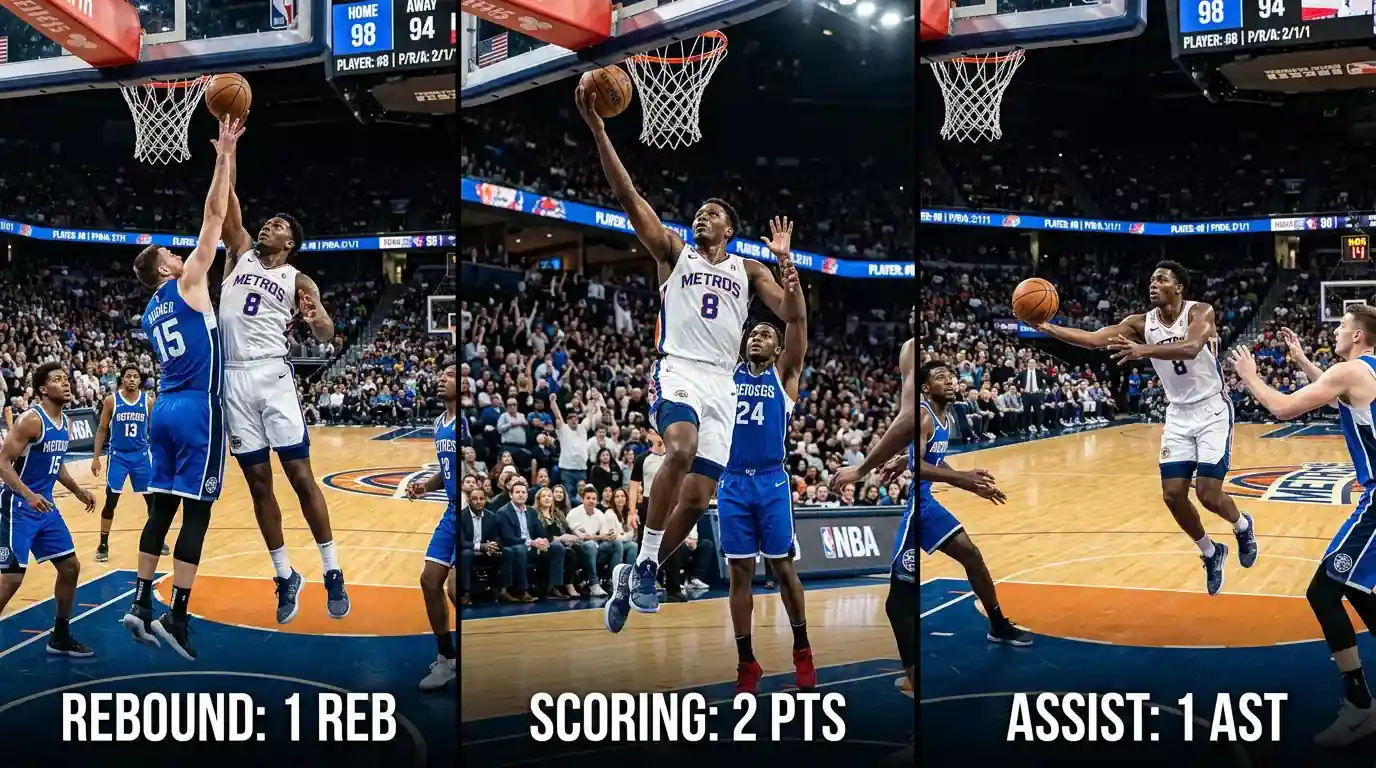
For scorers, pace expansion primarily increases shot attempts, which increases scoring opportunities proportionally — but only for players who score off of team possessions rather than through pure isolation creation. A player who creates most of his scoring through transition — catching the ball in the open floor after a defensive rebound — benefits enormously from high pace because those transition opportunities multiply directly with possessions. A player who creates through half-court isolation is less pace-sensitive because he generates his own opportunities regardless of team possession count.
For playmakers, pace expansion increases passing opportunities, which increases assist volume for point guards who initiate possessions. But the relationship is moderated by the specific type of passing the player does. A player who assists on catch-and-shoot three-pointers benefits from pace expansion because more possessions means more catch-and-shoot opportunities for his teammates. A player who primarily assists on post-touch plays is less affected, because those possessions are slower and less pace-dependent by nature.
For rebounders, the pace relationship runs through missed shots. More possessions produce more shot attempts, which produce more misses, which produce more rebounding opportunities. The strongest pace-rebounding relationship is for offensive rebounders, because offensive boards are essentially dependent on the number of missed shots — a direct function of possessions. Defensive rebounders see a similar but slightly more moderated effect because defensive rebound rate (how efficiently they clean up defensive boards) is the binding constraint, not raw opportunity count.
Using Pace Differential Between Two Teams as a Prop Angle
The specific prop angle I find most reliably exploitable from pace analysis is the pace mismatch game: when a fast team plays a slow team. This scenario creates predictable tension. The fast team wants to run in transition and generate high-pace offences; the slow team wants to limit possessions and control tempo. The game’s actual pace typically lands somewhere between the two teams’ preferences — but closer to the slower team’s average than a simple midpoint, because slowing down is generally easier than speeding up in basketball.
The implication: fast team players tend to underperform their pace-based projected totals when facing slow teams, because the slow team’s defence successfully constrains transition opportunities. Slow team players can exceed their pace-based projected totals when facing fast teams, because the fast team’s offence generates more misses and turnovers that create unexpected fast-break opportunities for the slower team’s players as well.
In both cases, the bookmaker’s prop line for players on the fast team is typically set using that team’s recent pace average, not the pace-adjusted projection for a game against a slow opponent. The slow team’s players’ lines are similarly anchored to their baseline. Testing the direction of those mismatches against the implied odds — and only acting when the directional confidence is high — is what transforms a pace observation into a specific prop betting decision.
For the full strategic context of how pace fits alongside usage, matchup, and injury factors in a pre-game research workflow, a complete NBA prop betting strategy puts each variable in its appropriate role rather than treating pace as the sole determinant.
How does playing a fast-paced team affect a big man’s rebounds prop line?
When a big man’s team faces an up-tempo opponent, more possessions generally mean more shot attempts and more missed shots — expanding the total rebounding opportunity pool. For defensive rebounders, the effect is meaningful but moderated by defensive rebound rate. For offensive rebounders, the effect is more direct: more missed shots by the opposing team means more offensive board opportunities. If the big man’s prop line was set without fully accounting for the pace expansion, the over becomes more attractive.
Do UK bookmakers factor in pace when setting NBA prop lines?
UK bookmakers incorporate pace into their models to varying degrees. Major player prop lines for star players tend to reflect pace more accurately because they receive more analytical attention and sharp money. Mid-tier and role player prop lines are more likely to anchor primarily on recent per-game averages without fully isolating the pace component. The resulting imprecision is where pace-aware bettors find their most reliable opportunities.
Created by the ”nba Props Bets” editorial team.